
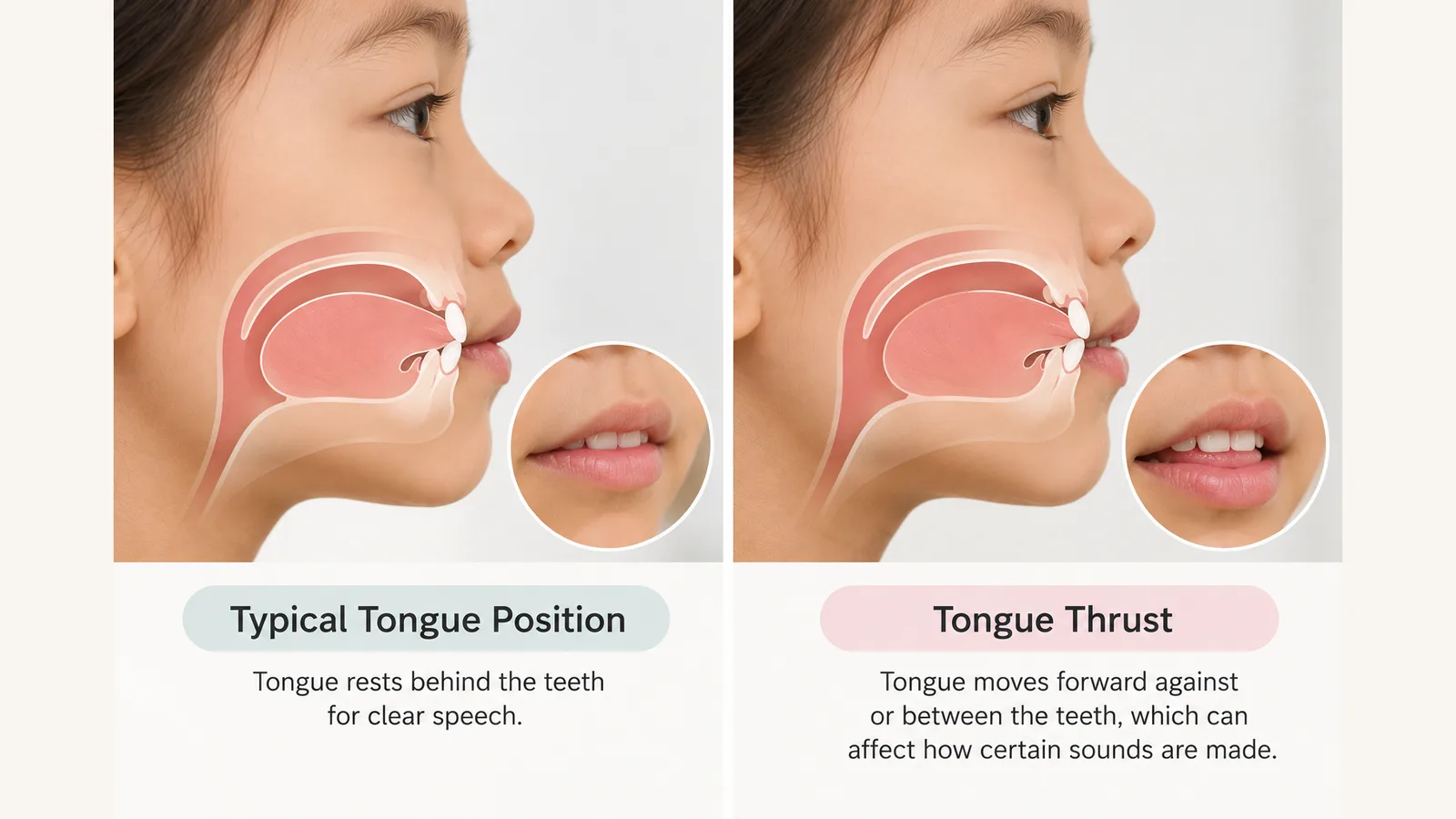
You took your child to the speech therapist, who said speech therapy. Then the dentist saw the same thing and said tongue thrust. That was three weeks ago, and you’ve been sitting with two different words from two different professionals, trying to work out who’s right — and quietly worried that you’re about to spend money on the wrong thing.
Neither of them is wrong. That’s the part nobody said out loud.
The two appointments that felt like contradictions
The speech therapist listened to your child say words with an /s/ in them and noticed the tongue coming forward between the front teeth instead of staying behind them. They called it an interdental lisp and talked about articulation.
The dentist watched your child swallow and noticed the same thing: the tongue pushing forward. They called it tongue thrust and mentioned how it can affect the teeth.
You walked out of two separate offices with two separate terms, and neither appointment mentioned the other.
Here’s why: each professional described what they were trained to see. The speech therapist hears a sound. The dentist sees a muscle pattern affecting the teeth. Both were looking at the same physical thing — the tongue coming forward — from opposite directions.
Each of them did their part well. The connection between the two just falls in the space between their specialties.
What they’re both watching
The tongue coming forward between the front teeth is the shared observation.
In speech, it changes how certain sounds are made — especially /s/ and /z/, which need the tongue tip to stay just behind the upper front teeth. When the tongue moves forward instead, the sound comes out differently. That’s the lisp.
In swallowing and at rest, the same forward movement is what myofunctional therapists call a tongue thrust. The tongue presses or moves forward when it shouldn’t — during a swallow, or just while resting.
These two things often show up in the same child. The American Speech-Language-Hearing Association (ASHA) lists distorted /s/ and /z/ sounds, often with an interdental lisp, among the signs of an orofacial myofunctional disorder — a pattern in how the tongue, lips and face muscles rest and move. But notice the careful word ASHA uses: the two can co-occur. Not “one causes the other.” They can appear together, in the same child, for related but distinct reasons.
The pattern is the same. The lens is different.
What the research actually says
A 2025 systematic review looked at 13 studies of children and teens, ages 4 to 18. The question it set out to answer was exactly the one you’re sitting with: does myofunctional therapy improve speech sound disorders?
The authors’ conclusion was plain: there is no conclusive evidence supporting myofunctional therapy as a standalone treatment for speech sound disorders. Myofunctional therapy alone, and myofunctional therapy combined with articulation therapy, was not found to be more effective than articulation therapy alone. The higher-quality studies showed no speech improvement that could be directly attributed to myofunctional therapy.
That’s an uncomfortable thing for a myofunctional therapy practice to say. We’re saying it anyway, because it’s true, and because you deserve a straight answer.
Myofunctional therapy is not a treatment for the lisp. The lisp is the speech therapist’s job.
If your child is already seeing a speech-language pathologist (SLP) for articulation, keep going. If you haven’t started, that’s where to begin. Speech has its own evidence base and its own experts, and the right person to address it is an SLP.
So what is myofunctional therapy for?
Myofunctional therapy works with the muscle habit itself: where the tongue rests, how it moves during a swallow, the pattern running in the background when your child isn’t speaking at all.
For some children, that muscle pattern may be worth addressing on its own terms — not because it will fix the lisp, but because resting tongue posture can affect how the face and jaw develop over time and how the teeth sit. It may also play a role in breathing, though that connection is still being studied.
Those are real concerns, separate from speech. Whether they apply to your child is something an evaluation can help determine — not a blog post.
If you’re still sorting out what you’re seeing, our article on 5 signs your child may need myofunctional therapy walks through the most common ones.
What to do from here
Start with the SLP, or keep going if you’ve already started. The speech piece belongs to them, and the research is clear that it belongs there.
If you’re wondering whether there’s also a muscle pattern worth looking at — whether resting posture and swallowing are part of what’s happening — a myofunctional evaluation can help answer that. Not instead of the SLP. Alongside.
ASHA frames it the same way: assessing these patterns has many possible parts, which “often require an integrated team approach.” Each specialist sees their piece, and the picture comes together when those pieces are put side by side.
The two professionals weren’t contradicting each other. They were each looking at the part in front of them. What you’ve been missing is someone who can explain how the parts relate.
Try this at dinner tonight
When your child says something with an /s/ in it — spaghetti, yes, their own name if it has one — watch the tongue. Does it come forward between the front teeth as the sound happens?
That’s what both professionals were seeing. Now you can see it too.
If you’re trying to figure out what’s worth pursuing, and in what order, that’s exactly what a free consultation is for — a conversation about what you’re seeing and what may help.
Joanne Nguyen, RDH, is a myofunctional therapist serving families in Orange County and Los Angeles County, with offices in Tustin, Long Beach, and Cerritos, and telehealth available.
Sources
- Effectiveness of Orofacial Myofunctional Therapy for Speech Sound Disorders in Children: A Systematic Review. International Journal of Orofacial Myology and Myofunctional Therapy, 2025. mdpi.com/2694-2526/51/1/4
- American Speech-Language-Hearing Association. Practice Portal: Orofacial Myofunctional Disorders. asha.org
